This series of articles, written by Gerard Besson and illustrated with images from the Paria Publishing Archives, was published by Newsday in a special magazine on 31st August 2013, in celebration of the 50th anniversary of Independence of Trinidad and Tobago.
Click here to see the entire magazine!
Racial prejudice was institutionalised to a fine point during the time of African slavery and in the later colonial period when East Indian indentureship was introduced. It was the experience of all who were not European. It defined dependence.
Broadly speaking, racial prejudice in the European sense came to the New World with the Spaniards, who, after winning a long and cruel war against the north African Moors who had crossed the straits of Gibraltar and conquered the Iberian peninsula in the 8th century, had finally been driven out in the 15th. With this, a type of ethnic cleansing commenced, which meant persons with Moorish (i.e. Islamic or even Jewish blood) were driven out of Catholic Spain. Thus the notion of ‘purity of the blood’ became the criterion for ‘nobility’ in Spain and was thence transported to the Spanish colonies in the New World.
In Trinidad, racial prejudice after the British conquest in 1797 achieved a fresh nuance. The Woodford administration (1813–1829) directed it at the Free Blacks and People of Colour as a ‘class’, notwithstanding the protection of their rights which were guaranteed under the Law. The educated, well-off, slave and property-owning Free Black People, who at emancipation in 1838 numbered 11,000, the largest free segment, responded with petitions. Eventually, a delegation led by the coloured planter Jean Baptiste Philippe left for London and met with the Secretary of State to the Colonies, Lord Bathhurst. They did not propose emancipation of the slaves; slavery is different from racial prejudice. Slavery was seen as an economic necessity practiced in Africa and in the Middle East that they as well as the Europeans accepted and subscribed to. They were interested in their right to inherit property, practice their professions and work in the public service, among other things. The case as presented by them was sound in law, inasmuch as the terms of the Cedula of Population, under the Spanish government, guaranteed certain rights for Free Blacks. The Articles of Surrender to the British by the Spanish Government in Trinidad in 1797 had maintained those rights. As said, the Cedula could be seen as the first constitution of Trinidad. With the court’s decision, the Free Blacks as a group had won a civil rights case, more than likely the first in this hemisphere.
The white French Creoles, a remnant of the royalists, were in a manner of speaking marooned here after the French Revolution. They worked mainly in the agricultural sector both in sugar and in cocoa, and despite being obsessed with the maintenance of pedigree, and never numbering more than 2,300 persons, identified with early forms of nationalism. The social and cultural influence of this group, sharing as they do the same historical narrative as both the slaves and Free Coloureds & Blacks, has been all-pervading in every aspect of civil society.
Out of these movements came a greater political awareness in the society on the whole. For people of African descent there was basically one way forward. First, an education must be sought at all cost. And second, European styles and mores, a certain French-ness, later, a more English manner had to be acquired as a method for identity formation. Law-abiding, with good Christian values, genteel manners, a much envied work ethic, and appreciation of western arts. All together, this meant respectability. Self-respect gave rise to a sense of responsibility. It was increasingly believed that having produced an educated middle class, it was time to reform the political status of the colony. Stringent controls of Crown Colony rule should be lifted and the introduction of democratic institutions should commence and be put into the hands of educated, responsible local men, notwithstanding their skin tone. This view was not accepted by the Colonial Office in London. There were calls for the recognition of Emancipation.
This call for change eventually became political and formulated itself into the Reform Movements of the 1850s on through to the turn of the century. The reformists expressed nationalists sentiments and were concerned with altering the nature of Crown Colony status so as to increase participation by local people in the colony’s political process. This was the hot-bed, the crucible of Afro-French-Creole politics of the late 19th century as expressed by people like Sir L.A.A. de Verteuil, Mzumbo Lazare, Maresse Smith, Phillip Rostant, C. Preudhomme David, Sir Henry Alcazar, Captain Cipriani, Albert Gomes and eventually C.L.R. James, Dr. Patrick Solomon and Dr. Eric Williams, to name a few. The genesis of the ‘politics of race’ was a natural reaction of the black intellectuals to the absurdity of British colonial prejudice which, more than anything else, insulted the intelligence of thinking people.
The East Indians of Trinidad, arriving from 1845 to 1917, had an entirely different political genesis. Living on the vast cane estates after the emancipation of the slaves, they escaped the emasculation of slavery, the loss of names and religion, which meant the loss of identity and the violence of the plantations. As the number of East Indians grew and their presence became more noticeable to the Creole population, it became obvious that the new-comers, as they were seen by the older inhabitants, were here to stay. Naturally, differences became obvious. In a place where miscegenation was the custom, it was noticeable that the East Indians kept to them selves. In a place where Christianity was seen as an important element of one’s identity, the worship of ‘gods’ was perceived as sacrilegious. In a society dedicated to spending so as to demonstrate status and a grasp on style, thrift was seen as meanness.
It came to a head over wages. The Indians became caught, through no fault of their own, in the politics of the day. The drama was being enacted in the island’s Legislature, between the planter and merchant interests, which promoted the idea of cheap labour, and the aforementioned other interests, which had formed around individuals who represented local concerns, meaning those who wanted reform of the island’s colonial status. Indian indentureship was perceived, especially by the black and coloured middle class professionals, as symbolic of the power and the privilege of the British colonial establishment.
There was hostility directed to the idea of imported Indian labour, because it affected black Trinidadian workers in the context of competition for wages in the labour market. Indians were at times vilified and stereotyped as willing to work for starvation wages; their frugal lifestyle appeared as ludicrous. It was felt that Indian immigration drove down wages and was the cause of unemployment and hardship among the black workers. Strong arguments were made that Indian immigration had become by then merely a weapon to allow planters to control the labour market by depressing wages to starvation levels. These ideas were popularised by newspapers such as the New Era and the San Fernando Gazette, which represented the view of the coloured and black middle class. This small pressure group consistently opposed Indian immigration publicly and at times bitterly, by enunciating the more offensive forms of racial stereotyping. The notion of perceiving the Indian population as not really belonging to the island’s overall population, when coupled with other negative stereotyping, produced in the minds of the generation of Afro-French/English Creole people born in the opening decades of the 20th century, as well as in the West Indian immigrants who were coming into Trinidad, a deep prejudice against a large and differentiating group of the population, in such a derogatory manner that when it was politicised in the 1950s and 60s, it would have lasting consequences.
The Reformists’ objection to the continued importation of free, or virtually free labour under the indentureship scheme in becoming an issue, created a lasting stereotype that became an accepted view. In such a manner are prejudices born and continue down through generations, even when the reasons and the purposes for them are no longer relevant and are even forgotten.
The start of Indian politics. Old roles of leadership, as practiced in the caste system in India, did not apply in the indentureship system on the estates. The mere crossing of the ocean had been enough to break that spell.
Conditions on the estates were also a great leveler. Leaders emerged from different quarters as necessitated by the managers’ requirements. ‘Surdars’, drivers and foremen, and shopkeepers of all and every condition and caste assumed leadership roles in estate yard and village life.
The earliest Indian organisation in this island, the East Indian National Organisation, came into existence in 1897, more than 50 years after J.B. Phillips petition to Lord Bathurst, to organise a campaign to protest an ordinance, No. 12 of 1897, which contained several sections that infringed on the rights of the East Indians. This body was to outlive its original purpose, and its efforts after 1898 served to increase East Indian self-awareness. It has to be remembered that this was now more than fifty years after the Fatel Rozack docked in Port of Spain, and a great number of families of Indian descent were by now in their second and third generation of being Trinidadians.
Also in 1897, a group of East Indians submitted a memorandum to the West Indian Commission, in which they requested for the first time direct representation by an East Indian member in the Legislative Council. This was unsuccessful. But as Dr. Bridget Brereton observes in her book Modern Times, “The request highlighted a growing political awareness; it indicated that Indians were beginning to consider themselves as an identifiable group with its own interests, different and separate from those of other groups and with demands to be articulated.”
By and large, East Indian politics was fifty years behind the Reformist Movement of the Creoles. Leaders like Sir Henry Alcazar, Maxwell Philip K.C. and Vincent Brown K.C., for example, were already practiced speakers on the nominated benches of the Legislative Council in the 1880s and ‘90s.
It was out of the organisation of labour that East Indians were to assume leadership roles that were larger than the estate yard or village life. This process commenced with lowering of wages and the increase of task work. Professor Kusha Harraksingh states:
“This was a recurring planter strategy which the nature of the task system itself conveniently accommodated.”
Many factors contributed to the unionisation of sugar workers that eventually occurred in 1937, not the least of which was the end of indentureship in 1917 and the switch over to free, unindentured labour.
Professor Harracksingh also notes that the “concentration of ownership of the sugar industry was in a few hands ... the growth of a peasant sector of small and middle-sized cane farms without their own processing facilities; the development of party politics ... and the identification of sugar workers with a particular ethnic and cultural group.”
The East Indian National Association in Princes Town was joined by another organisation, called the Indian National Congress, which was centered in Couva. The aim of these bodies was to encourage Indians to take an active and intelligent part in both community life and in the broader scheme of things. The Trinidad Citizens League, formed by Adrian Cola Rienzi (Krishna Deonarine), was a party that mainly appealed to sugar workers. It was branded as communist by the colonial government.
In 1942, almost a century after East Indians had settled here, the right of adult franchise was granted by the colonial authority, hard won and hard fought for by the 19th century reformists and the trade unions, produced from their ranks, in the strikes of the 1920s and 30s and in the killing fields of the Red House fire, Apex and Fyzabad.
For the East Indians, it created a great political impasse. The ordinance demanded that the voter could cast a vote only if he was qualified in the English language. The majority of the East Indians were illiterate and very few of them had a command of English. As V.M. Vidyarthi, columnists, wrote in his article ‘Indian to Trinidadian’: “The language test therefore would have almost exclusively and adversely affected the Indian Community in the exercise of its votes, should it be allowed to function.” It was perceived as the most notorious element in the political setup and called for a united force to fight it. It united the East Indians, and their organisations finally succeeded in removing the test. Thus, equal opportunity for all races to participate fully in the political process was achieved, albeit within the structure of colonial Trinidad. The small steps taken by the Indian community in contributing to the creation of the colony’s political life were to be conveniently forgotten by many after Independence.
The first election with universal adult suffrage was held in 1946. A large number of independents and various political groupings contested the election.
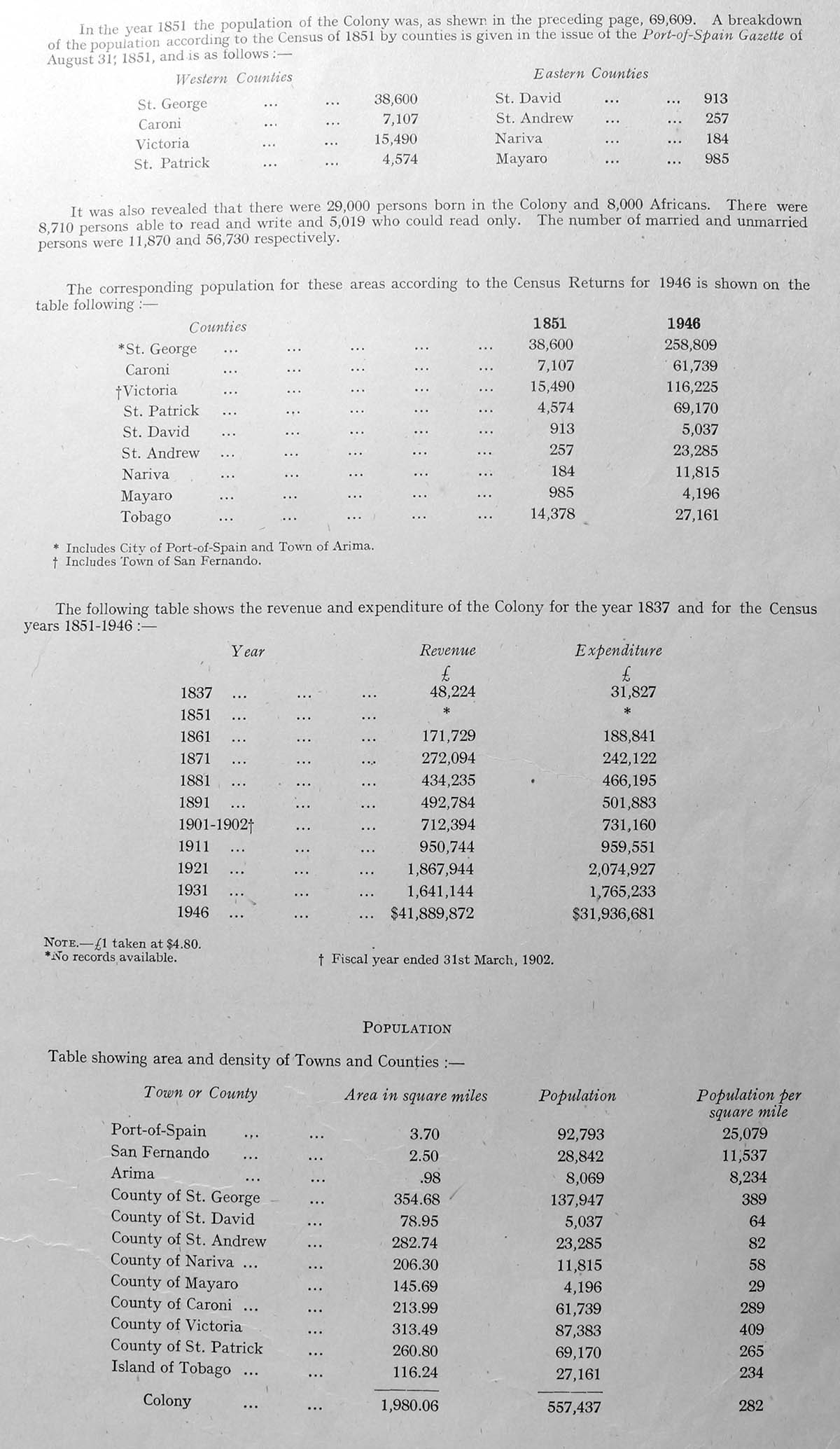
Men of Indian descent obtained four out of the nine elected seats. At this point, East Indians formed 35% of the island’s population. It is thus very significant that they actually captured 44% of the elected seats.
In 1950, the second election was held under a new constitution. The entire colony was divided into 18 constituencies with an almost equal population. Fifty-one candidates were put up by five different political groups, and 90 independents contested. Five independents and 13 party candidates were elected. Among these seven were East Indians (four Hindus and three Christians). This represented 39% of the total elected seats. In his article, Vidyarthi writes: “A Constitutional Reform Committee under the chairmanship of Ashford. Sinanan, a member of the Legislative Council, was appointed in 1955. This committee recommended the creation of a British type of cabinet government under an elected Chief Minister.
After minor modifications, the recommendations were implemented and the introduction of these reforms were hailed as a significant political advance. It gave rise in the minds of some that the age of Party Politics had commenced.”
In 1956, the elections were held under the new constitution, in which 8 parties put up 89 candidates to contest 24 seats. Among these, the Trinidad Labour Party and Uriah Butler’s Party were the oldest. The Trinidad Labour Party was founded by Captain A.A. Cipriani and advocated self-government.
The East Indian leadership at this point was divided into two groups. Leaders like Sarran Teelucksingh, Timothy Roodal and Adrian Kola Rienzi formed an association with Cipriani and the T.L.P. and had the support of East Indian organisations.
The other party in the race was the People’s Democratic Party, formed by Bhadase Sagan Maraj. For many years he reigned supreme as one of the top East Indian leaders in Trinidad.
Bhadase was a man of wide influence and dynamic personality, who advanced the status of the entire East Indian community. First elected as an independent to the Legislative Council in 1950, in ‘53 he founded the Peoples Democratic Party and in the same year became the leader of the Sugar Worker’s and Cane Farmer’s Union.
The most significant entry into the political arena in 1956 was the People’s National Movement, PNM, under the leadership of Dr. Eric Williams. He changed everything in Trinidad & Tobago’s politics.
The P.N.M. entered the election campaign with a clear-cut programme. It declared that the people of Trinidad had had six years of corruption, mismanagement and party acrobatics in public affairs.
It presented a multiracial slate of candidates and based its appeal on West Indian nationalism. It commanded black professional, black labour and black urban support. Dr. Williams also commenced an educational programme at Woodford Square in an atmosphere that may only be described as messianic.
Under pressure to gain popular support from the P.N.M., the leadership of the P.D.P. tried to modify its purely East Indian character and promoted multi-racialism and secularism from its platforms. It lent its support to the Party of Political Progress Groups, headed by Albert Gomes, the most significant person on the political scene since Captain A.A. Cipriani. The P.D.P. also supported the Butler Party and the Trinidad Labour Party as well as several independents.
From the results of the 1956 election, in which the P.N.M. secured the majority of seats and formed the government, it was clear that the time of the independents was over. The P.N.M. victory was the result of better organisation and leadership that was speaking to a well prepared constituency. It was also the result of an assertion of Black self respect and self confidence that felt it self ready to leave behind an identity shaped by the depredations of the British colonial experience that had created the ‘Afro-Saxon’ identity. A new ‘national’ identity was in the offing, designed and created by the charismatic Dr. Eric Williams, supported by a confident black middle class that had struggled against colonial dominance for close to 150 years, with its roots firmly placed in the 19th century colonial reform movements, buttressed by substantial West Indian immigration (appox. 80,000 in the 20,&30s) that had a much longer history of slavery and had known harsher oppressions in the other islands.
On July 18th, 1957, at a special meeting of the representatives of the P.D.P., the F.L.P. and the P.O.P.P.G., a decision was taken to dissolve their parties and form the Democratic Labour Party. On January 8th, 1958, Badhase Sagan Maraj, the former head of the P.D.P. and the President-General of the Sanatan Dharma Maha Sabha, the largest Hindu religious body in Trinidad, was elected leader of the parliamentary wing of the D.L.P., which by this time was recognised as the official opposition party in the Legislative Council.
With this development, the two-party system came into being, shared between the P.N.M. with its ‘African’ support and the D.L.P. with its ‘Indian’ base. The D.L.P. was successful in the federal elections. However, times were changing. Despite Bhadase’s popularity and his influence on the East Indian masses, the younger generation of educated and enlightened groups found him to be an embarrassing leader. He was uneducated and no match for Dr. Eric Williams. They thought that Bhadase’s manners crude and his methods suspicious.
To match the intellectual glamour of Dr. Williams, a section of the D.L.P. looked for leadership elsewhere, as the old “chief” had become less effective and increasingly unwell. The D.L.P. was divided upon itself during this period (as in later years) and A.P.T. James of Tobago took the helm.
He too was no match either for the brilliance or eloquence of Dr. Eric Williams. During this period, there were many defections to the P.N.M., as both Christian and Muslim intellectuals crossed over to the winning side. The D.L.P. leadership passed to Dr. Rudranath Capildeo, a staunch Sanatanist Hindu. Dr. Capildeo, like Dr. Williams, was an island scholarship winner. He had earned his Ph.D. from London University. He was an acknowledged mathematician and physicist. It was felt that if Dr. Capildeo headed the D.L.P., he would be able, together East Indian intellectuals and professionals, to exert enough influence on the rural masses to achieve cohesion as well as satisfy non-Indians alienated from the P.N.M. with the intellectual capacity they wanted. Despite fierce factional fighting between the Bhadase supporters and the young intellectuals, concern of another P.N.M. victory eventually forced the closing of the ranks behind the new leader.
But Dr. Capildeo was no politician. Unlike Dr. Williams, he had not created a political party of his own, but was rather placed at the head of a party by a group of shrewd and experienced politicians who wanted to use him and his academic achievements for getting votes. Dr. Kenneth Lalla comments on the 1961 elections and quotes Dr. Selwyn Ryan:–
“As a forerunner to the 1961 general elections, the P.N.M. government announced its intention not only to re-draw the electoral boundaries but also to compile a new voters’ register and to introduce voting machines.”
The Indians’ reaction to those proposals was that they pointed out that these new voting arrangements were calculated to curtail the voting strength of the Indians, which had been demonstrated against the P.N.M. in the 1958 federal elections. They further argued that the replacement of the ballot box by voting machines was also designed to frustrate illiterate Indians. Did the P.N.M. manipulate the distribution of the voting population on a racial basis so as to give more seats to the P.N.M.? On this issue Dr. Selwyn Ryan commented:
“The P.N.M. took no chances even in Port of Spain, where the boundaries were redrafted, to make sure that all potential D.L.P. areas, i.e. the upper class and upper middle-class residential areas, were attached to working class areas where the P.N.M. had been consistently strong. The D.L.P. was not given an outside chance to gain a seat in the capital city as they had done in the 1958 and 1959 municipal elections. In the countryside, there was strong evidence to substantiate the D.L.P. claim that the P.N.M. had herded as many Indian voters as was possible into constituencies which they could not possibly win, and had extracted from such areas large blocks of Negro voters who were then recombined into the other constituencies.” (from Race and Nationalism 1961, pp. 144-45)”
Dr. Capildeo as Prime Minister! This was the dream of many and perhaps it was his dream as well, an Indian Prime Minister, just imagine!
Under his leadership, the D.L.P. captured ten out of thirty seats. The highest voter turnout was in St. Augustine, where he was the candidate. The D.L.P. candidates were returned from the rural areas, mainly the sugar belt. Out of the ten seats gained, eight were East Indians and two were of African descent.
The eight East Indians consisted of three Hindus, one Muslim and four Christians. Among these Ashford Sinanan, Simboonath Capildeo, Lionel Frank Seukeran and Stephen Maharaj were elected to the Legislative Council. The other six members, new to the political arena, were Dr. Capildeo, political leader, Tajmool Hosein, Vernon Jamada, Balgobin Ramdeen, M. Forrester and Peter Farquhar.
In 1962, Trinidad and Tobago achieved full independence. Some of the opposition’s demands were rejected. Dr. Capildeo had failed at the Marlborough House talks in London, and in many quarters it was felt that their cause had been betrayed.
Captain Arthur Cipriani
was born in 1875.Coming from an upper class French Creole family, he had open to him a choice of careers. He instead opted to devote his life to public service. By the turn of the century, he had become a solicitor and was already earning a reputation as the ‘champion of the barefoot man’. His prestige was such that he was able to raise three contingents to serve in the Great War, leaving with the third. Upon his return he accepted the Presidency of the Trinidad Workingmen’s Association, which had been started some 20 years previously. C.L.R. James, who wrote of Cipriani’s career, said, “if there is anything which can prove the fitness of the people of Trinidad for self-government, is the progress of this Association.” Determined to make meaningful changes in civil society, Cipriani took the Association island-wide. From one section in P.O.S. he established 42 sections, with 6 in P.O.S. and 13 in Tobago. He established the Assoc.’s paper, ‘The Labour Leader’, which was circulated to the thousands of members, in which matters of government policy were discussed and explained, labour issues addressed and strategies outlined. As such legislation was passed under which workers were granted compensation for injury and death. He secured shorter working hours for workers in the retail sector, and among other gains saw to the creation of an Agricultural Bank that could facilitate low-interest loans for farmers. He was seven times Mayor of P.O.S. and oversaw many of its major improvements. Regarded by his peers as an officer and a gentleman, ‘the Captain’ definitely had the common touch. He was the spokesman for the people in the Legislative Council in which he served for 15 years. C.L.R. James wrote of him, “No public man is more widely known in Trinidad. . .Many West Indians, and a few Englishmen too, have worked for the emancipation of the West Indies. Their stories will be told in time, but no one has worked like Captain Arthur Andrew Cipriani.”
Sir Hugh Wooding
was just 38 years old when he became Mayor of P.O.S. in 1942. The photo at left shows him wearing the Mayoral chain. In a very real way, both the youthful vigor and the sense of civil responsibility depicted here characterised the career of this most outstanding of men. Born in 1904, he attended Moulton Hall Weslyean School and then Queen’s Royal College. An island scholarship winner in 1923, he left for London and the Middle Temple, where he gained First Class honours in all his Bar examinations. And, because fortune favours the brilliant, he was also able to capture the first prize for Constitution Law and Legal History, 300 guineas. He was called to the Bar in 1926 and entered the Chambers of Sir Lennox O’Reilly. He was appointed K.C. in 1948. He was a member of the Bar Association and became the first Vice President in 1957 and President in 1960 of the West Indies Bar Assoc. He received the “Special 1960 Citation of Honour” from the Caribbean League of America. In 1963 he became Kt. Bachelor, having received the C.B.E. in 1957. Wooding served on a number of important public bodies, boards etc., during his career, notably the Trinidad and Tobago Electricity Commission; the Planning and Housing Commission; the Central Board of Health; Trinidad and Tobago Welfare Ltd.; the Railway board and was Chief Registration Officer of Constitutional Reform Committee. An eminent Freemason, he left an indelible inscription on the Craft. He was a Director of several important business organisations, notably Trinidad Broadcasting Co. Ltd., President of British West Indian Airways as well as of the Caribbean Development Corporation, founded by Sir Gerald White, and the Chairman of Alstons Ltd.
In 1962 he was appointed the first Chief Justice of newly independent Trinidad and Tobago. The ‘Wooding Court’ included Justices Achong, Reese, McMillian, Peterkin, Scott, de la Bastide, Malone, Hassanali, Fraser, McShine, Phillips, and Corbin. Several of these distinguished personalities would go on to serve this country in its highest offices. Sir Hugh Wooding became Chancellor of the University of the West Indies in 1971. He will be remembered as a man who pioneered the route which many were to follow.
The Birth of Pan
Modern times also brought the innovative nature inherent in all of us to the fore with the invention of the steel-pan. It just had to be. Berti Gomes said of it: “The Second World War saw the birth of the ‘steelband’. It was both an innovation in musical expression and a social explosion in Trinidad. It also provided an unparalleled instance of puritan humbug. It would be impossible to trace the origins of the steel bands. These must always remain shrouded in mystery and the subject of endless speculation—all things considered, a not surprising genesis for this musical aberration and gimcrack orchestration, whose romantic odyssey spans an arc of picaresque adventure that began in the slum areas in Port of Spain, recently reached Cape Kennedy, and is still orbiting.” (Excerpt from ‘Through a Maze of Colour’.)
Albert Gomes
was one of those ‘born Trinidadians’ who fitted in everywhere in the 1940s and 50s, and somehow didn’t. Born of poor Portuguese parents in the rough part of Belmont, at a time when the Portugese were not considered socially white, Berti grew up hard. From young he had a lot of social conscience and spoke out against ingrained colonial attitudes, particularly when it had to do with racial prejudice and the stereotyping of black people. This led him into politics. Demanding workers’ rights, more pay, and criticizing the colonial power structure with what was considered revolutionary arguments, Berti was seen by the authorities as a leftist and a threat to the system. In the early 1930s he joined the Federated Workers Union and became its President. He was elected to the Port of Spain City Council in 1938 and served there for some nine years. He challenged the colonial establishment and resisted all attempts by the Government to dominate the Council, sometimes using his considerable size and weight to accomplish these ends, such as when he lay down upon the Council’s table and refused to budge until his intentions were agreed upon. He worked tirelessly for West Indian integration. Naturally this made him very popular.
In 1945 he was elected a member of the Legislative Council, and in 1946 he became a member of the Executive Council. From 1950 to 1956 Gomes was re-elected to the Legislative Council . He was the leader of the conservative Party of Political Progress Groups (POPPG). From 1958, he served as a member of the West Indian Federal House of Representatives, which was dissolved at the break-up of the Federation in 1962. When the POPPG was defeated by the only nine-month old People’s National Movement (PNM) in the 1956 election by winning 13 out of the 24 seats (with just 1,458 votes more than the POPPG) Berti took the defeat very badly and left to live in England where he died some years later. Gomes also had an outstanding literary career being the author of several books and published articles.
Dr. Eric Williams
was an exceptional person. Understanding the relationship of history to politics, he single-handedly and successfully set out to de-construct of the British interpenetration of history.
He commenced this task while still a young man with his doctoral thesis, “The Economic Aspects of the Abolition of the Slave Trade and West Indian Slavery’ Oxford, 1939. This work was later published as ‘Capitalism and Slavery’. Williams’ thesis debunked the notion that slavery was abolished because of ‘Justice and humanity’ as claimed, but solely for economic reasons.
He went on to politicise his views upon his return to home, taking his theories to the public in a unique way by embarking on a series of lectures which he delivered in a professorial manner from the bandstand of Woodford Square. Williams was an excellent speaker and a charismatic personality who both entertained his listeners but also enlightened them as to their condition of colonial victimhood. His nationalistic exhortations, patriotic in content, emotionally appealing and racially biased, were pivotal to his becoming the outstanding Caribbean populist leader of his generation. The political party created by him in 1956, the People’s National Movement, went on to dominate the political landscape of Trinidad and Tobago for decades.
Eric Williams was born on the 25th September 1911 at 16 Dundonald Street, P.O.S. He came from what was know at that time as the Afro-French-Creole educated middle class, as both his mother and father were products of the Free People of Colour recorded from the late 18th century of Grenada and Trinidad. He attended Tranquillity Boys Intermediate School and Queen’s Royal College. Winning a scholarship, he attended Oxford University, he was later to lecture at Howard University, U.S.A.
In 1964 he was admitted to the Privy Council. He would refuse a knighthood but accept the more acclaimed award of Companion of Honour.
Buy "The Book of Trinidad" by clicking here:
Buy "A Rada Community in Trinidad" by clicking here: